


An enterprise transitioning from being data-centric to becoming data-driven needs to adopt coordinated project management disciplines and appropriate technical enablement processes. When organisations face challenges in leveraging data for decision making, it is not typically due to a lack of available data but rather due to the absence of a clear plan to convert their data into an easily consumable intelligence asset. In addition to aligning the business goals, technical architecture, and user adoption strategies, an effective implementation cycle exceeds just the implementation of the software itself.
By navigating the project lifecycle, whether that be reports that are relevant or dashboards that provide enough visibility for making high volatility decisions, you will enable your organisation to obtain maximum value from its data. Leaders who desire to lead this initiative can follow the Microsoft Power BI Course curriculum as a structured, guided learning path that will provide them with the technical leadership to develop a scalable solution and continue to evolve the solution as their organisation’s business requirements change over time.
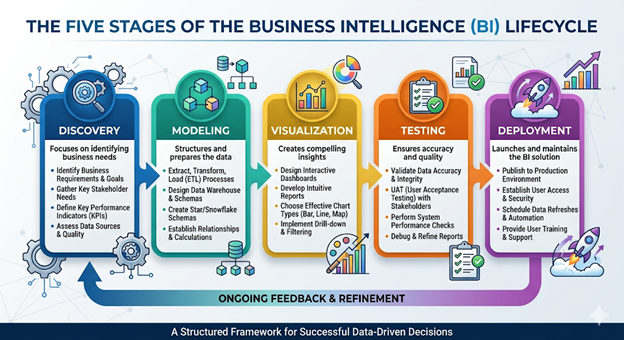
Complete Process of Implementation
Using well-defined, documented workflows, all technical components necessary for the successful implementation of Power BI will be provided while still allowing for flexible adjustment to changing requirements, specifically in relation to updated business logic.
- Gathering requirements – gather KPIs and define the questions that the dashboard should answer.
- The development of an ETL script and backend architecture will enable a data structure to be built with reliable data flow.
- The UAT will enable stakeholder confirmation of report accuracy; therefore, ensuring report numbers match the data source.
- Production deployment: moving reports to a secure workspace, setting up auto refresh schedules, and enabling mobile access.
Self-Service BI vs Managed Enterprise BI Comparison
This is a major topic in a Power BI Certification Course. It sets the company’s governance model and helps you understand the balance between user freedom and organizational control.
| Feature | Self-Service BI | Managed Enterprise BI |
| Responsibility | Departments only | Central IT/Data Team |
| Data Control | High flexibility, lesser consistency | High consistency, strict management |
| Speed to Insight | Fast / Ad-hoc | Periodic / Standardized |
| Best For | Exploratory Analysis | Regulatory and Executive Reporting |
Modern Market Tools + AI Integration
The market is heading for “Augmented Analytics,” where the system does more than just tell you what happened. With tools like Azure Machine Learning, Power BI can now do “Key Influencer” analysis that automatically determines which factors (price, season, etc.) are the most impacting a certain metric. These types of integrations are what transform a dashboard from a static display to a predictive engine.
Individuals looking for specialized training in a growing city can take a Power BI Course in Pune, which generally focuses on advanced integrations to prepare them for jobs in the large IT and automotive industries throughout Pune. For example, one might think about a logistics company using a live dashboard view of all fleet movements with the aid of artificial intelligence, predicting delays to deliveries from real-time traffic data and sending notifications directly through Teams to the manager automatically as they occur.
Best Practices for Architecture
- Version Control: Track changes in reporting files using OneDrive or SharePoint integrated into a report so those changes track through the reporting history and avoid any potential data loss in reporting.
- Parameterization: Maintain the ability to quickly transition from “Development” to “Production” data sources without having to rewrite each of the queries.
- Optimizing DAX: Providing time-intelligence measures via a focus on Generate functions or CALCULATE functions across queries will allow for year-over-year comparisons with a minimum amount of latency.
Conclusion
Success on any business intelligence project is based on the ability to communicate and provide accurate and timely answers to any business question within the execution time frame required. By using established implementation lifecycle processes as well as the new AI-based capabilities, the developer can produce accurate and impactful reports. Taking a Microsoft Power BI Course gives you the entire set of skills needed to navigate all aspects of the complicated data journey from beginning to end. A strong professional base can help create more than just graphs – it helps create a culture of making informed and strategic decisions.
