


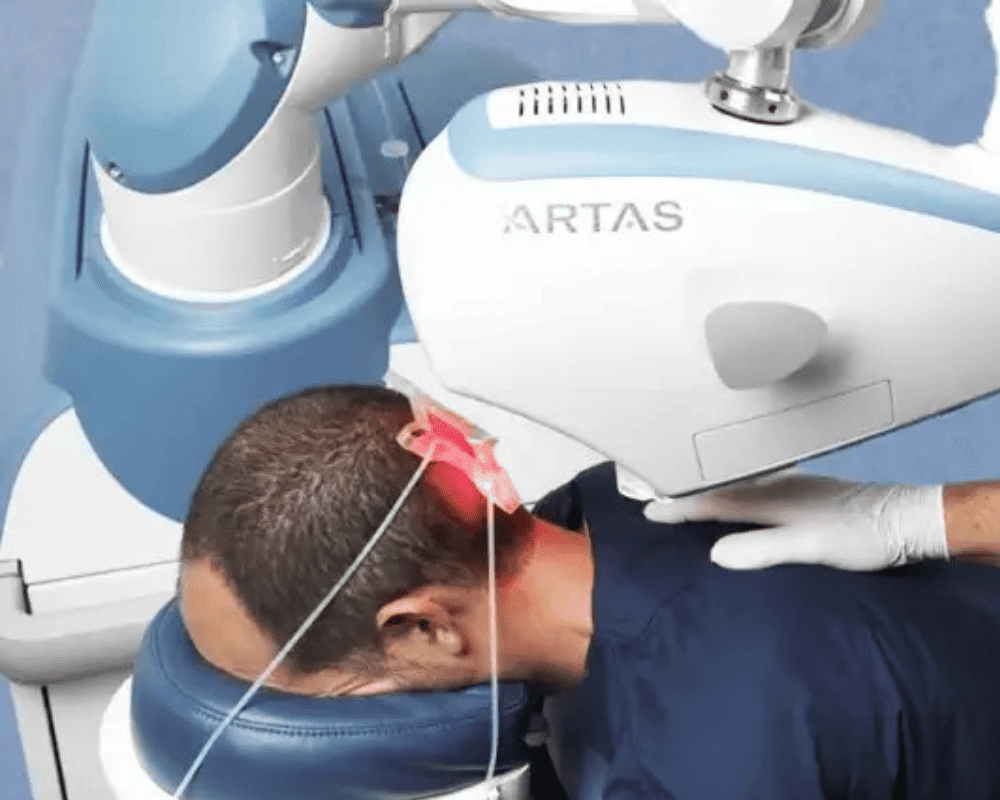
Donor-area mapping is one of the most important planning stages in a Robotic Hair Transplant in Dubai because the procedure depends on identifying suitable follicular units without unnecessarily depleting the scalp. Computer-assisted imaging can help locate and evaluate follicles, while the surgeon determines which areas are appropriate for extraction and how the donor supply should be preserved.
The objective is not simply to harvest the largest possible number of grafts. It is to obtain suitable follicles from a sustainable donor region while maintaining a natural appearance and protecting options for future hair restoration.
How Robotic Hair Transplant in Dubai Uses Donor Mapping
The donor area is typically located toward the back and sides of the scalp, where follicles may demonstrate greater resistance to androgenetic hair loss.
Before extraction, the region needs to be evaluated for density, follicular-unit characteristics, hair direction, and overall suitability.
Robotic Hair Transplant in Dubai Can Assist With Follicle Identification
Computer-assisted systems can analyze the donor region and help identify individual follicular units.
This can provide useful visual information about follicle distribution and potential extraction targets. The technology, however, operates within a treatment plan established by the medical team.
Robotic Hair Transplant in Dubai Still Requires Clinical Assessment
Imaging cannot independently determine whether every visible follicle should be harvested.
The surgeon must consider the patient’s:
- Donor density
- Hair caliber
- Follicular-unit composition
- Existing donor depletion
- Pattern of hair loss
- Recipient requirements
- Future restoration needs
- Scalp characteristics
This clinical interpretation prevents the donor area from being treated as an unlimited source of grafts.
Why the Donor Area Is a Limited Resource
Unlike many cosmetic procedures where the treated tissue can be modified repeatedly, donor follicles are finite.
Once a follicular unit has been extracted, that specific unit is no longer available for another procedure.
Donor preservation affects future options
A patient with early hair loss may eventually experience additional recession or crown thinning.
If too many grafts are harvested during the first procedure, there may be fewer options available for future restoration.
Extraction density must be controlled
Harvesting every available follicle from a region would not necessarily produce the best cosmetic outcome.
Extraction should be distributed strategically so that the donor area continues to look natural after healing.
What Donor Mapping Evaluates
A useful donor assessment goes beyond simply counting hairs.
| Donor characteristic | Why it matters |
|---|---|
| Follicular density | Indicates available graft supply |
| Hair caliber | Influences visual coverage |
| Follicular-unit composition | Determines hairs available per graft |
| Growth direction | Helps guide extraction |
| Donor-zone stability | Helps assess long-term suitability |
| Previous extraction | Identifies existing depletion |
| Scalp characteristics | Influences surgical planning |
| Future hair-loss pattern | Helps determine how much donor supply to preserve |
The combination of these factors provides a more useful picture than a simple graft-count estimate.
How Follicle Direction Influences Robotic Hair Transplant in Dubai
Follicles are not positioned vertically beneath the scalp.
They emerge at specific angles and can change direction across different parts of the donor region.
Robotic Hair Transplant in Dubai Must Account for Follicle Angulation
An extraction device needs to approach a follicular unit in a way that follows its natural trajectory.
Incorrect alignment can increase the risk of follicular transection, where part of the follicular structure is damaged during extraction.
Hair direction varies across the donor zone
The direction of follicles near the occipital scalp can differ from those around the temporal regions.
This makes anatomical recognition important even when computerized mapping is available.
Donor Density Is Not the Same as Graft Availability
A scalp may appear densely covered while containing different follicular-unit distributions.
For example, one patient may have many single-hair units, while another may have a greater proportion of two- or three-hair units.
Why follicular-unit composition matters
Graft count describes follicular units, not individual hairs.
If a graft contains multiple hairs, the number of visible hairs obtained from a given graft count can differ considerably between patients.
This is one reason why donor assessment should consider both graft density and hair characteristics.
Safe Donor-Zone Planning
A suitable donor zone should be defined carefully before extraction.
The permanent zone concept
The surgeon assesses areas expected to retain relatively stable hair characteristics over time.
This does not mean that every follicle within a traditional donor-zone boundary is guaranteed to remain unaffected throughout life. Individual variation and progressive hair loss must still be considered.
Avoiding overharvesting
Overharvesting can create visible gaps or reduced density in the donor area.
A balanced extraction pattern distributes removal across appropriate regions rather than concentrating it into a small section.
Robotic Hair Transplant in Dubai and Hairline Restoration
Donor mapping also has to be connected to the recipient objective.
A patient seeking frontal restoration may need a different graft composition from someone requiring extensive crown coverage.
Fine grafts may have greater value at the hairline
Single-hair units can be useful for creating a softer leading edge.
Multi-hair grafts may be better suited to areas farther behind the frontal transition when appropriate.
The surgeon therefore needs to know not only how many grafts can potentially be extracted, but also what types of grafts are available.
Donor characteristics influence hairline planning
If the donor region contains predominantly coarse or multi-hair units, these characteristics need to be considered when designing the frontal transition.
Natural restoration depends on matching graft characteristics with their intended recipient location.
Robotic Hair Transplant in Dubai and Crown Restoration
Crown treatment presents a different allocation problem.
The crown can cover a relatively broad area and contains a natural rotational whorl.
Crown restoration can consume substantial donor resources
As the thinning area expands, more grafts may be required to produce meaningful visual coverage.
The surgeon must therefore balance the current crown requirement against the remaining donor supply.
Existing crown hair changes the strategy
If native hairs remain, transplantation can focus on increasing density rather than reconstructing the entire region.
This can allow grafts to be allocated more selectively.
Mapping the Donor Area Before Extraction
The preoperative assessment should establish a clear extraction strategy.
A typical planning sequence includes:
- Examination of donor density.
- Identification of suitable donor regions.
- Assessment of follicular-unit composition.
- Evaluation of hair direction and angle.
- Mapping of potential extraction sites.
- Estimation of sustainable graft availability.
- Matching donor characteristics to recipient requirements.
- Establishing a long-term donor preservation strategy.
The robotic system can support parts of this process, but medical judgment remains responsible for the final plan.
Why Robotic Hair Transplant in Dubai Is Not Simply Automated Harvesting
The term “robotic” can create the impression that the entire operation is performed automatically.
That interpretation is misleading.
Robotic assistance is better understood as a technological component within a surgical procedure.
Technology supports precision
Computerized imaging and robotic mechanisms can assist with selected technical tasks.
The surgeon controls the strategy
The medical team determines:
- Whether transplantation is appropriate
- Which donor regions should be used
- How many grafts should be harvested
- Which grafts should be prioritized
- How the recipient area should be designed
- How grafts should be distributed
- How future hair loss should influence the plan
The technology is therefore most useful when integrated into experienced clinical decision-making.
Donor Mapping for Different Hair-Loss Patterns
The same donor strategy does not apply to every patient.
| Hair-loss pattern | Donor planning priority |
|---|---|
| Early frontal recession | Preserve supply for possible progression |
| Advanced frontal loss | Balance hairline reconstruction with donor reserve |
| Crown thinning | Consider recipient-area expansion |
| Diffuse thinning | Evaluate donor and recipient stability carefully |
| Temple recession | Identify appropriate fine-graft requirements |
| Previous transplant | Account for existing donor depletion |
A personalized map helps prevent the treatment from being based on a generic graft template.
Previous Hair Transplantation Changes Donor Mapping
Patients who have already undergone FUE or another transplant require particularly careful evaluation.
Previous extractions may have reduced donor density, even when the area still appears relatively full.
Existing scars can affect assessment
Small extraction marks may be difficult to identify visually without magnification.
Computer-assisted imaging can provide additional information, but the surgeon must interpret the findings and determine whether further harvesting is appropriate.
Revision surgery requires conservative planning
If donor capacity has already been reduced, preserving the remaining follicles becomes even more important.
The objective may shift from maximizing extraction to achieving the most useful improvement with a limited donor reserve.
For patients researching robotic donor mapping in Dubai, the assessment should connect computerized follicle identification with donor preservation and the specific recipient requirements of the restoration plan.
Read More: 1 Dirham Hair Transplant in Dubai: Cost for Early Hair Loss
Dubai-Specific Donor and Recovery Considerations
Dubai’s environmental conditions should also be considered when planning the procedure.
Strong sunlight and high temperatures can make postoperative scalp protection especially important. Patients may need to reduce direct outdoor exposure during the early healing period according to their surgeon’s instructions.
Air conditioning can also create a dry indoor environment. Patients should follow the recommended postoperative scalp-care routine rather than introducing products that have not been approved by their medical team.
A practical recovery schedule is particularly relevant for patients with demanding professional, social, or travel commitments.
Questions About Robotic Hair Transplant in Dubai Donor Mapping
What is donor-area mapping?
Donor mapping is the process of assessing and identifying suitable follicular units for extraction while considering density, follicle characteristics, growth direction, and long-term donor preservation.
Can robotic technology identify every suitable graft?
Technology can assist with follicle identification, but the surgeon determines which grafts are clinically appropriate for extraction.
Does high donor density mean unlimited graft availability?
No. Donor follicles are finite, and extraction must be limited to preserve a natural donor appearance and future treatment options.
Can donor follicles be taken from anywhere on the scalp?
Not necessarily. The suitability of a donor region depends on follicular stability, density, hair characteristics, and the patient’s individual hair-loss pattern.
What happens if the donor area has already been depleted?
The surgeon must assess the remaining donor supply and determine whether additional extraction is appropriate. A conservative strategy may be necessary.
Does robotic extraction prevent follicle damage?
No extraction technique can guarantee zero follicular injury. Careful mapping, alignment, surgical technique, and graft handling all influence follicular integrity.
The Strategic Investment in Robotic Hair Transplant in Dubai
A successful robotic restoration begins before the first follicle is extracted. Accurate donor mapping helps determine which follicles can be harvested, how extraction should be distributed, and how much donor capacity should remain available for the future.
The strongest treatment strategy combines technology with anatomical knowledge rather than relying on automation alone. When donor mapping, graft selection, recipient design, and implantation are coordinated, the available follicular resource can be used more intelligently.
For patients considering Robotic Hair Transplant in Dubai, Tajmeels Clinic provides hair-restoration assessment focused on the relationship between donor availability, recipient requirements, and long-term restoration planning.